- Home
- Guides
- Sourcing & Private Label
- Sourcing Car Air Fresheners from China
Sourcing Car Air Fresheners from China
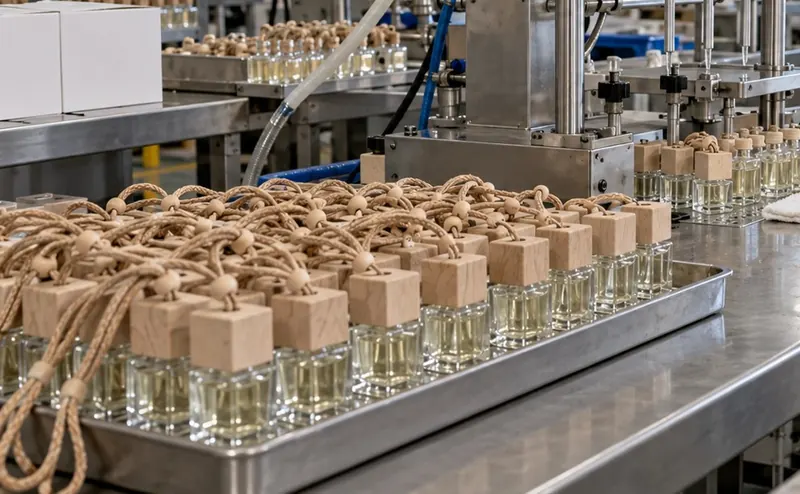
Sourcing from China works best in order: define the product and market, shortlist suppliers, sample, agree terms, approve pre-production, inspect, ship and reorder. Each stage builds on the one before it.
Most car air fresheners sold around the world, from paper hangers at gas stations to refillable vent diffusers in auto-parts chains, are made in China. That gives buyers a wide choice of formats, materials and price points. It also means a buyer has to make many decisions in the right order: what exactly to buy, for which market, from whom, to what specification, and how to confirm that what arrives matches what was approved.
This guide maps the full sourcing process from the first brief to repeat orders. Each stage links to a deeper guide where one exists.
The sourcing map at a glance
| Stage | What you decide | What you should hold at the end |
|---|---|---|
| 1. Brief | Format, scents, branding, packaging, target market, channel, quantity range | A written brief (one page is enough) |
| 2. Shortlist | Which suppliers actually make or reliably supply your format | 2–4 suppliers with evidence of relevant products |
| 3. Samples | Which construction, scent and finish meet your needs | Evaluated samples with written feedback |
| 4. Quote | Price per unit on equal assumptions, plus terms | Comparable quotations |
| 5. Pre-production | Final artwork, scent references, packaging | A signed-off specification and approved sample |
| 6. Production | Inspection method and acceptance criteria | Inspection result, packing list, documents |
| 7. Shipping | Incoterm, freight mode, consignee duties | Booked shipment and shipping documents |
| 8. Reorder | What stays fixed, what changes | Version-controlled specification for repeat orders |
The order matters. Buyers who ask for prices before they know the format, packaging and market usually receive quotes that cannot be compared, and then spend weeks clarifying.
STAGE 1Define the product and the market
A good brief answers six questions.
1. Which format? Paper hanging card, vent clip, hanging bottle diffuser, gel can, fiber can, dashboard perfume, visor clip, membrane, ceramic or wooden diffuser, electric diffuser, spray, odor absorber. Each format has different costs, release behavior, packaging and documents. If you are unsure, start with the channel: impulse retail favors low-price paper and vent formats; gift and premium channels favor glass diffusers, wooden tops and sets; car washes and detailers use sprays and hangers. See Types of Car Air Fresheners: Formats Compared.
2. Which market and channel? Where the product will be sold changes the packaging language, label content, document needs and sometimes the format itself. Some jurisdictions restrict objects hanging from the rear-view mirror; some retailers require barcodes and specific carton marks; online marketplaces have their own listing and compliance checks. Write down the country and the channel before you contact anyone.
3. Which scents? Choose a small number of scent directions (for example fresh, citrus, woody, sweet, new-car style) and describe them in your own words. Do not ask a supplier to copy a branded scent by name. See Car Fragrance Families and Scent Selection.
4. Which branding? Neutral stock product, your logo on a stock shape, a custom shape, or a full private label range with your own packaging. Each step adds artwork work and possibly tooling.
5. Which packaging? Bag with header card, blister, window box, printed box, display box for retail counters, or bulk pack for promotional distribution.
6. Which quantities? Give a realistic range per item and per scent for the first order and for a typical reorder. Quantities change price, packaging choices and how flexibly scents can be split.
Tip: If you do not know an answer yet, say so in the brief. "Undecided between vent clip and visor clip" is useful information; a supplier can then quote both.
A structured template is in Car Air Freshener RFQ: What to Include.
STAGE 2Shortlist suppliers
The Chinese car fragrance supply base includes several kinds of companies:
- Manufacturers who mold, fill, print or assemble the product in their own facility.
- Manufacturers with a partner network, who make some formats in-house and coordinate others (for example glass bottles, wooden caps or electronic modules) through regular partners.
- Trading companies who source from several factories and handle communication and export.
All three can be valid choices. What matters is that you know which applies to your product, so you know who controls quality, scent filling, packaging and schedules. Ask directly: "For this item, which steps happen in your facility, and which are done by partners?"
What to check on a shortlist
- Product fit: does the supplier show the same format and similar construction you need, not only similar-looking photos?
- Evidence: real factory or product photos, sample quality, documents they can provide for the fragrance and product, and clear answers about their process.
- Communication: do they ask useful questions about your market and quantities, or simply send a price list?
- Customization range: printing methods, packaging options, scent development, tooling.
A scoring approach is in How to Choose a Car Air Freshener Supplier.
STAGE 3Samples
There are two kinds of samples, and confusing them causes problems:
- Stock samples show the supplier's existing products, constructions and scents. They help you choose a format and judge basic quality.
- Custom or pre-production samples are made to your artwork, scent and packaging. They are the reference for production.
When samples arrive, evaluate them under the same conditions: same car or room, same time of day, coded scent strips if several people judge scents, and written notes. Record what you liked, what must change, and what is acceptable. See How to Evaluate Car Air Freshener Samples and How to Compare Car Fragrance Scent Samples.
STAGE 4Quotation and order terms
A quotation is only comparable if it rests on the same assumptions. Before comparing prices, check:
- the same construction, size and materials;
- the same fragrance load or equivalent fragrance specification;
- the same packaging, printing colors and carton marks;
- the same quantity per item and per scent;
- what is included: plates, cutting dies, molds, samples, documents, inspection;
- the delivery term (for example FOB or EXW, using the current Incoterms rules) and the named place;
- payment terms and the validity period of the quote.
A lower unit price often hides a thinner material, smaller fill, simpler packaging, or costs that appear later. See Comparing Car Air Freshener Supplier Quotes and Car Air Freshener Landed Cost: A Worksheet.
STAGE 5Pre-production approval
Before production starts, everyone should look at the same thing. A complete approval pack includes:
- final artwork files for the product and packaging, with color references;
- the approved scent references (sample codes or fragrance codes);
- dimensions, materials and fill quantity;
- packaging specification: pack type, inserts, barcode, carton marks, units per inner and outer carton;
- the approved physical sample, kept by both sides.
Changes after approval are possible but usually reset part of the schedule. See Car Air Freshener Order Timeline and Car Air Freshener Packaging: Choosing a Structure.
STAGE 6Production, documents and inspection
Documents depend on the format and market. Common ones include a Safety Data Sheet (SDS) for the fragrance or finished liquid product, a fragrance supplier's IFRA conformity document for the intended use, product test reports where your market or customer requires them, and battery documents for electric diffusers. An IFRA document is issued for a fragrance and its use; it is not a certificate for the finished product. See Car Air Freshener Quality: Tests and Documents and Documents and market requirements.
Inspection checks the finished goods against the approved specification before shipment. Agree in advance what will be checked (appearance, dimensions, printing, fill, packaging, carton marks, quantity, function where relevant), how many units will be sampled, and what happens with defects. See Car Air Freshener Pre-Shipment Inspection.
STAGE 7Shipping and delivery
Shipping decisions include:
- Incoterm and responsibilities: who books freight, who pays which costs, where risk transfers.
- Freight mode: sea (FCL or LCL), air or express. Many car fragrance products contain liquid fragrance or alcohol, and electric diffusers contain batteries. These details affect classification and the routes and carriers that will accept the goods. Classification is decided from the product's SDS and confirmed by your forwarder. See Shipping Car Air Fresheners: Classification Questions.
- Import duties and rules in the destination market, handled by the importer of record and a customs broker. See Importing Car Air Fresheners into the US for one example.
- Packing list and carton data: carton dimensions, weights and volumes so freight can be planned. See Car Fragrance Cartons, CBM and Packing Lists.
STAGE 8Reorders
The first order is the hardest. Reorders should be easy, provided the specification is kept under control:
- keep a version number on artwork and packaging files;
- keep fragrance codes, not just scent names;
- record any approved changes with dates;
- share sell-out data or forecasts so the next order can be planned before stock runs out.
See Reorder and supply support.
Common mistakes
| Mistake | Better approach |
|---|---|
| Asking for "your best price" with no specification | Send a brief with format, packaging, market and quantity ranges |
| Comparing quotes with different fill sizes or packaging | Normalize the specification first |
| Approving artwork on screen only | Approve a printed or physical sample |
| Naming a branded scent or copying a trademarked shape | Describe the scent direction in your own words; use your own shapes |
| Assuming a document covers every product | Check which product, fragrance version and use a document actually covers |
| Leaving shipping classification to the last week | Share SDS and battery information with your forwarder early |
| Changing scents after approval without recording it | Version-control every change |
FAQ
Do I need to visit the factory?
A visit helps for large or long-term programs, but many buyers start with video calls, samples and third-party inspection. What matters is that you can see the supplier's role and the product evidence clearly.
Can I mix different formats and scents in one order?
Usually yes. Mixed orders are common for distributors and retailers. Quantities per item and per scent affect price and lead time, so state them in the brief.
Should I work with a trading company or a manufacturer?
Either can work. Ask which steps happen where, who controls quality and scent filling, and who you speak to when something goes wrong.
Ready to start a brief?
Tell us the format, market and quantities you have in mind, and we will come back with the questions and options that apply to your project.
Related: OEM and private label · Factory and production · Request samples
Tell us your format, market and quantities and we reply with options.
We make car air fresheners for brands, importers and promotional buyers, and help them plan formats, scents, packaging and documents from brief to reorder.
Ready to start a brief?
Start a sourcing brief
Tell us the format, market and quantities you have in mind, and we come back with the options and pricing that fit your project.
Prefer to start with samples?